


Views: 0 Author: Site Editor Publish Time: 2026-05-12 Origin: Site


Electric forklift or diesel forklift? For procurement managers across North America, Europe, and Southeast Asia, this question has become more consequential than ever. Rising fuel costs, tightening emissions regulations, and the shifting economics of supply chains have changed the calculus — and for most indoor and mixed-use operations, the answer has shifted decisively toward electric.
This guide provides everything you need to evaluate the two technologies side by side: operating economics, performance characteristics, application fit, and the total cost of ownership over a realistic ownership cycle. Whether you're running a single warehouse in the U.S. or building out a manufacturing fleet across Southeast Asia, the framework is the same.
Who This Guide Is Written For
Target Reader | Pain Point | Search Intent |
Warehouse & Ops Buyer (US/EU) | Section 301 tariffs on China forklifts; emission compliance; labor shortage | 'electric forklift vs diesel' | 'non-China forklift manufacturer' |
Target Reader | Pain Point | Search Intent |
SEA Factory Equipment Manager | China forklifts break down; Japan too expensive; boss wants ROI data | 'electric forklift Southeast Asia' | 'Taiwan forklift vs China' |
Electric forklifts are powered by rechargeable battery packs — either lead-acid or lithium-ion. The drive system converts stored electrical energy into torque through an electric motor, delivering instant, proportional response from the moment the operator touches the throttle. There is no combustion, no exhaust, and no warm-up period.
Modern electric forklifts use AC (alternating current) motor systems, which represent a meaningful step forward from older DC designs. AC motors are more thermally efficient, require fewer serviceable components (no brushes to replace), and provide regenerative braking that returns energy to the battery during deceleration. The Noveltek EC Series uses AC motor technology across its electric forklift lineup.
Diesel forklifts use an internal combustion engine fueled by diesel. They generate torque through a conventional drivetrain, typically with a torque converter and automatic transmission. This architecture delivers strong sustained traction on outdoor terrain — particularly on grades or uneven surfaces — but comes with the full maintenance overhead of an engine-based system: oil changes, fuel filters, cooling systems, exhaust components, and more.
For indoor use, diesel forklifts present a fundamental problem: exhaust. Carbon monoxide, nitrogen oxides, and particulate matter make diesel unsuitable for enclosed spaces without significant ventilation infrastructure.
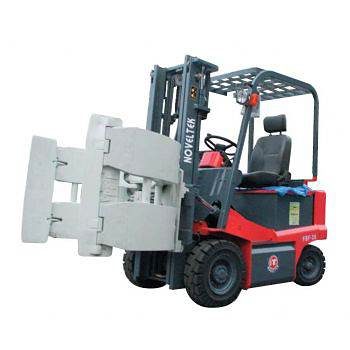
Purchase price is the wrong frame for this decision. The more useful question is: what does it cost to own and operate each machine over 3 to 5 years? For most facilities, the TCO calculation strongly favors electric.
Cost Category | Electric Forklift | Diesel Forklift | Advantage |
Purchase price | Comparable or slightly higher | Comparable or slightly lower | Diesel (slight) |
Fuel / energy cost | Electricity (low, stable) | Diesel (high, volatile) | Electric |
Preventive maintenance | Lower — fewer systems | Higher — engine + exhaust | Electric |
Unplanned repairs | Lower — fewer failure points | Higher — engine complexity | Electric |
Operator idle time | Minimal (opportunity charge) | Warm-up + refueling stops | Electric |
Ventilation / compliance | None required | Required for indoor use | Electric |
Battery replacement (lead-acid) | Periodic cost (5–7 year cycle) | N/A | Comparable |
Resale value trend | Improving as market shifts | Declining in regulated markets | Electric |
SEA Buyer Note — TCO Is the Right Frame For Southeast Asian procurement teams evaluating against locally assembled alternatives: the purchase price gap often closes or reverses by Year 2, once fuel savings, lower repair frequency, and reduced parts costs are factored in. A Taiwan-manufactured AC electric forklift with a 36-year OEM track record typically delivers a lower 3-year TCO than a locally assembled unit that requires more frequent servicing. |
Performance Dimension | Electric Forklift | Diesel Forklift |
Torque delivery | Instant — no lag from start | Builds with RPM |
Low-speed precision | Excellent — smooth throttle control | Adequate |
Sustained outdoor performance | Limited by terrain | Strong on grades and rough surface |
Cold storage suitability | Preferred — zero exhaust heat | Not recommended |
Noise level | Low — operator and ambient comfort | High — hearing protection often required |
Multi-shift capability (lithium) | Yes — fast charge between shifts | Yes — quick refuel |
High-altitude performance | Unaffected | Reduced (thinner air affects combustion) |
OSHA standards (29 CFR 1926.602 and related guidance) require adequate ventilation when internal combustion forklifts are used indoors. In practice, this means exhaust fans, monitoring equipment, and operational restrictions that add ongoing cost and complexity.
The regulatory environment is tightening, not relaxing. California's Air Resources Board has already mandated zero-emission equipment transitions for certain warehouse categories. Several other U.S. states are following with similar frameworks. For food and beverage processing, pharmaceutical manufacturing, and cold chain logistics, electric isn't just a preference — it's the only viable option for indoor operations.
In Southeast Asia, green building standards and ESG requirements from multinational clients are beginning to drive similar transitions, particularly in export-oriented manufacturing hubs in Vietnam, Thailand, and Indonesia.
Application | Electric Forklift | Diesel Forklift | Recommended |
Indoor warehouse (all climates) | Ideal | Requires ventilation | Electric |
Cold storage / refrigerated | Preferred | Not suitable | Electric |
Food, beverage, pharma | Ideal | Not suitable | Electric |
Manufacturing floor (indoor) | Ideal | Limited | Electric |
Outdoor yard — paved | Many models suitable | Strong performer | Evaluate by model |
Rough terrain / unpaved | Limited | Preferred | Diesel |
Tropical / high-humidity facilities | Well suited (zero exhaust heat) | Adequate | Electric |
Multi-shift (with lithium battery) | Well suited | Well suited | Electric (lithium) |
ESG / green building compliance | Fully compliant | May require offsets | Electric |
For buyers in both North America and Southeast Asia, sourcing country is increasingly part of the equipment decision — not just because of tariffs, but because of supply chain reliability, quality consistency, and service network depth.
Chinese-manufactured forklifts and powered industrial trucks are subject to a 25% Section 301 tariff as of current regulations. Products manufactured in Taiwan qualify as Non-China Origin and are exempt. For a U.S. buyer purchasing a fleet of electric forklifts, the tariff difference alone can represent a substantial cost delta — before any quality or service considerations enter the conversation.
In Southeast Asia, the choice is typically framed as locally assembled alternatives (lowest purchase price, variable quality) vs. Japan-origin equipment (premium quality, premium price). Taiwan-manufactured forklifts from established OEM suppliers occupy a strategic middle position: comparable quality to Japanese counterparts, at pricing that is more accessible and with shorter lead times.
Noveltek's 36-year track record as an OEM supplier to leading Japanese industrial brands provides a quality signal that Southeast Asian procurement teams can point to when justifying the decision to move up from locally assembled equipment. The same machines supplied to exacting Japanese clients are available directly under the Noveltek brand.
Noveltek at a Glance Founded 1990 | 36 years manufacturing experience | ISO 9001 certified (2005) | CE certified (2009) | 100% Made in Taiwan | Exports to 38 countries | ~80% export ratio | Full AC motor lineup | Lithium battery options available |
If you've decided on electric, the next question is battery chemistry. Lead-acid remains the most widely deployed technology, with lower upfront cost and a well-established service ecosystem. Lithium-ion is the direction the market is moving — and for good reasons:
Factor | Lead-Acid | Lithium-Ion |
Upfront cost | Lower | Higher |
Charge time (full) | 6–8 hours | Faster — model dependent |
Opportunity charging | Not recommended (damages cells) | Yes — no memory effect |
Cycle life | Shorter | Longer |
Maintenance | Watering, equalization charges required | Minimal — sealed system |
Best for | Single-shift, predictable schedule | Multi-shift, high-throughput ops |
SEA climate suitability | Standard | Better thermal stability in high heat |
Q: What is an electric forklift and how does it differ from a diesel model?
An electric forklift is powered by a rechargeable battery pack driving one or more electric motors, while a diesel forklift uses an internal combustion engine fueled by diesel. The core operational differences are: electric produces zero direct emissions (making it suitable for indoor use), requires significantly less maintenance (no engine oil, fuel filters, or exhaust systems), and delivers instant torque from a standing start. Diesel offers stronger sustained outdoor traction but carries higher operating costs and indoor compliance requirements.
Q: Is an electric forklift more expensive than diesel in the long run?
For indoor and mixed-use operations, the total cost of ownership over a 5-to-10-year period typically favors electric — even when accounting for battery costs and charging infrastructure. The savings come from lower energy costs per operating hour, reduced maintenance frequency, and less operator idle time. The upfront price gap has also narrowed significantly as electric technology has matured.
Q: Can electric forklifts handle outdoor operations?
Many electric forklift models are suitable for outdoor use on paved or hard-surface yards. For rough terrain, steep grades, or unpaved surfaces, diesel remains the stronger performer. When evaluating a specific model for outdoor use, check the manufacturer's specifications for tire type, ground clearance, and IP rating for weather exposure.
Q: What battery should I specify — lead-acid or lithium-ion?
For single-shift operations with a predictable charging schedule, lead-acid remains a cost-effective choice. For two-shift or three-shift operations, high-utilization facilities, or environments where opportunity charging between shifts is necessary, lithium-ion is the better long-term investment — it supports faster charging, a longer cycle life, and requires no water maintenance.
Q: Why are Southeast Asian buyers choosing Taiwan-made forklifts over China-made alternatives?
The primary drivers are quality reliability and total cost of ownership. China-made alternatives may carry a lower purchase price, but procurement managers in the region consistently report higher repair frequency, parts availability challenges, and shorter equipment lifespans. Taiwan-made forklifts from established OEM manufacturers offer comparable quality to Japanese-origin equipment, at more competitive pricing — with the additional advantage of a documented quality history serving export markets in Japan, Europe, and North America.
Q: Does Noveltek offer OEM or private-label options for distributors?
Yes. Noveltek provides OEM, ODM, and OBM services. International distributors and equipment dealers can source Noveltek equipment under their own brand, with custom specifications, labeling, and documentation. This is a common arrangement for regional distributors in North America, Europe, and Southeast Asia.
Further Reading: Electric Forklift vs Diesel Forklift: A Complete Buyer's Guide
Ready to Compare Models and Get a Quote?Contact Noveltek for a free consultation — electric forklift specs, battery options, and pricing. |


